Choosing a recarburizer: CPC, GPC or calcined anthracite for your melt?
Recarburizer choice for grey iron, ductile iron and steel: fixed carbon, sulphur, nitrogen, recovery and the cost per kg of dissolved carbon. When GPC pays.
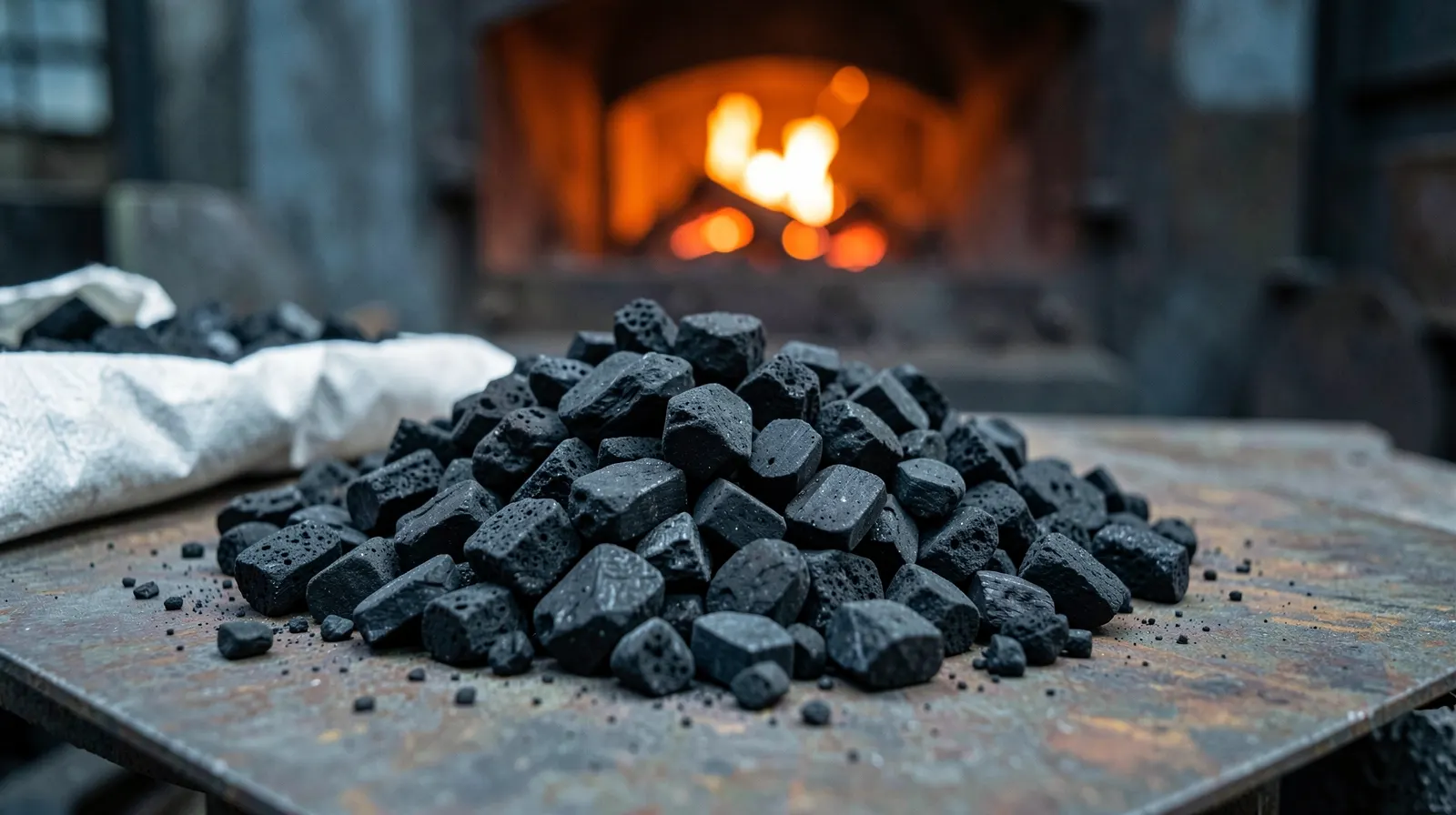
The first question we get about recarburizers is almost always the price per tonne. Fair, but not everything you charge ends up in the iron. Some turns into slag, some burns, and some is still floating undissolved when you tap. The unit that matters is the cost of one kilogram of carbon actually dissolved in the melt.
Short answer: Calcined anthracite (90-95% C) is good enough for cheap carbon in grey iron and in steel charges; added with the solid charge, it averaged 84% recovery in laboratory trials. CPC (calcined petroleum coke) reached about 91% in the same trials, but its sulphur (≤0.5%) eats magnesium in ductile iron. Graphitized petroleum coke (GPC) dissolves fastest and most completely and carries ≤0.05% S. In ductile iron and low-carbon steel the premium usually comes back.
Same element, different crystals
All three are carbon; what separates them is crystal order and what comes along for the ride. Calcined anthracite is coal with the volatiles driven off: 90-95% fixed carbon, a few percent ash. CPC is refinery coke after calcining; fixed carbon goes above 98.5%, but the sulphur and nitrogen from the feedstock stay in the structure. GPC is the same coke taken to 2,500-3,000 °C. Most of the sulphur and nitrogen leave and the layers reorganise into graphite.
X-ray diffraction work by Janerka's group at the Silesian University of Technology makes this concrete. Anthracite and petroleum coke are "turbostratic": their layers are roughly parallel but randomly rotated, with crystallites only a few nanometres in size. In synthetic graphite the crystallites are around 20 nm high and hold 50-70 graphene layers each. Ordered graphite dissolves faster in molten iron.
Recovery: carbon on the certificate vs carbon in the ladle
The same group melted pure steel scrap in a 20 kg high-frequency induction furnace, and we still use their numbers when we build quotes. Added with the solid charge, average recovery was 84.4% for anthracite, 90.6% for petroleum coke and roughly 99% for synthetic graphite. Thrown onto the liquid surface, the ranking shifted: anthracite 63.4%, petroleum coke 80.5%, synthetic graphite 77.5%.
Two details get lost on the shop floor. Recovery falls as the bath picks up carbon. Anthracite gave 96.6% when the starting carbon was 0.1%, and dropped to 77% once the melt reached 2.2% C. Synthetic graphite stayed above 95% across the whole range. And on the surface, synthetic graphite was gone in 4 minutes, anthracite in 6, petroleum coke in 8.
GPC is not identical to synthetic graphite, but the higher its degree of graphitization, the closer it behaves. Lines that trim with GPC land nearer their carbon target; that is what we see.
Sulphur and nitrogen: who pays for the defect
In grey iron, sulphur is not the enemy. Somewhere around 0.05-0.10% it even helps graphite nucleation. Ductile iron is the opposite story. Every kilogram of sulphur that gets tied up takes about 0.76 kg of magnesium with it (MgS, 24.3/32). A high-sulphur recarburizer pushes the FeSiMg addition up, and when residual Mg runs short, nodularity suffers. We covered the fade window separately in the FeSiMg article.
Nitrogen is grey iron's problem. Elkem's technical notes put nitrogen fissures and pinholes mostly in medium and heavy sections next to resin-bonded cores or moulds. The fix: low-nitrogen recarburizers and binders, plus a zirconium-bearing inoculant to lock residual nitrogen up as nitride. For a sense of scale, a CPC sample reported by Janerka and co-workers in 2022 carried 1.5% S and 6,000 ppm N. Not every CPC looks like that, but the label guarantees little. No nitrogen line on the COA? Ask for one.
A typical case: months of clean castings, then pinholes in heavy sections. Same sand, same binder. The only change is a cheaper lot of carbon raiser. Put the nitrogen figures of old and new lots side by side first.
What a kilogram of dissolved carbon costs
The formula is short: Cost of dissolved C = price per tonne ÷ (fixed carbon × recovery)
Illustrative round prices, not market prices: Calcined anthracite 400 $/t, CPC 550 $/t, GPC 750 $/t. Fixed carbon 92% for anthracite, 98.5% for the cokes; recovery from the Janerka solid-charge averages (synthetic graphite standing in for GPC, an optimistic assumption).
Calcined anthracite: 400 ÷ (0.92 × 0.844) = about 0.52 $ per kg of dissolved C. CPC: 550 ÷ (0.985 × 0.906) = about 0.62 $. GPC: 750 ÷ (0.985 × 0.99) = about 0.77 $.
On paper, anthracite wins. Now add sulphur. Say you need 10 kg of dissolved carbon to lift one tonne of ductile base iron by 1% C. If every gram of sulphur reports to the melt (worst case), the 11.2 kg CPC addition brings 56 g of sulphur. Tying that up needs roughly 43 g of Mg. With an FeSiMg at 6% Mg and 50% Mg recovery, that is 1.4 kg of extra FeSiMg per tonne. At an illustrative 2,000 $/t for FeSiMg, the bill is about 2.8 $ per tonne of iron. The carbon cost gap between CPC and GPC for the same tonne is 1.5 $. So in ductile iron GPC comes out ahead before you put any price on nodularity risk. Grey iron carries no such penalty.
Measure recovery in your own furnace: carbon before and after plus the weighed addition, over five heats.
When the cheap option is fine
Anthracite does the job in grey iron with thin sections and a low-nitrogen moulding system. It also suits the first carbon into a steel charge, while bath carbon is low and recovery high. Count the ash (up to 4%) as slag: about half a kilogram at a 13 kg addition.
CPC is the middle ground. It works as the main carbon source in grey iron, and in ductile iron only with lots whose COA shows low sulphur.
GPC earns its price in ductile iron, in steel grades that need low sulphur and low nitrogen, and for the last carbon trim before tapping. A furnace held at temperature has its own electricity bill.
Timing the addition and picking a grain size
Charge it with the solid scrap, ideally between the first layers. In the Janerka trials, solid-charge recovery ran 10-20 percentage points above surface addition. Carbon dropped onto slag gets trapped or burns, and induction stirring works hardest during meltdown.
For grain size, 1-5 mm works well in induction furnaces. Fines under 0.5 mm blow away during charging and float on the bath. Pieces over 10 mm dissolve late, especially once the bath is already near its carbon target.
Damp material brings hydrogen, so check any big bag that has been standing outdoors before it goes in. Starting with anthracite and doing the final trim with the same material is another classic; recovery drops at high carbon, the target keeps slipping and the addition creeps up. On SiC lines, forgetting the carbon the SiC already brings means overshooting. We worked through that balance in the SiC article.
Our recommendation as of October 2026
Expert view, with a date on it: a foundry buying for the last quarter of 2026 should treat recarburizer as a two-step purchase. Take the base carbon for grey iron from calcined anthracite or CPC, and for ductile iron and steel from GPC; in every case, do the final pre-tap trim with GPC. For two weeks in November or December, log addition, starting carbon and final carbon on every heat. Sign the January 2027 contract on the cost per kg of dissolved carbon from those two weeks, and let price per tonne come second.
Frequently Asked Questions
Is a carbon raiser the same thing as a recarburizer? Yes, and "carburizer" means the same. Anthracite, CPC, GPC and synthetic graphite all belong here.
Can I use CPC in ductile iron? You can, but check the sulphur on the COA and adjust the FeSiMg addition to match. A CPC at ≤0.5% S can bring up to 56 g of sulphur per tonne for a 1% carbon pickup in the worst case. If your line runs close to the nodularity limit, GPC is the safer pick.
When should the recarburizer go in? The main addition with the solid charge, between the first layers of scrap. Use fast-dissolving GPC for small corrections before tapping. Do not throw it onto the slag.
Should I suspect the recarburizer when pinholes appear? In heavy grey iron sections and around resin-bonded cores, yes. Compare the nitrogen value of the new lot with the old one, switch to a low-nitrogen carbon raiser and, if needed, tie up residual nitrogen with an FeSiZr inoculant.
Arsam Metal supplies all three recarburizers in 1-5 mm: CPC at fixed carbon ≥98.5%, S ≤0.5%, ash ≤0.5%; GPC at fixed carbon ≥98.5%, S ≤0.05%, ash ≤0.5%; calcined anthracite at fixed carbon 90-95%, S ≤0.3%, N ≤300 ppm, ash ≤4%. Every lot ships with a COA. Ask for all three in one quote and we will work out the dissolved-carbon cost with your furnace data: RFQ form.
Sources: Janerka K., Bartocha D., Szajnar J., Cholewa M., "The influence of different kind of carburizers and carburization on the effectiveness and iron structure", Archives of Metallurgy and Materials 52(3), 2007 (PDF) · Janerka K., Bartocha D., Szajnar J., Jezierski J., "The carburizer influence on the crystallization process and the microstructure of synthetic cast iron", Archives of Metallurgy and Materials 55(3), 2010 (PDF) · Janerka K. et al., "Various aspects of application of silicon carbide in the process of cast iron melting", Archives of Metallurgy and Materials 67(3), 2022, doi:10.24425/amm.2022.139708 · Elkem, "Surface defects" technical advice (elkem.com).
Mehdi
Technical Metallurgist
Facing a similar problem?
Arsam's technical desk handles every supply and production question: same-day quote (4-hour target), technical consulting included.