
Si Metal 441 or 553? Choosing the right grade for aluminum casting and silicone chemistry
Si Metal 441 (Fe≤0.4%, Ca≤0.1%) vs 553 (Fe≤0.5%, Ca≤0.3%): Al-Si casting intermetallics, Rochow-process trace-element control, and the real grade-cost call.
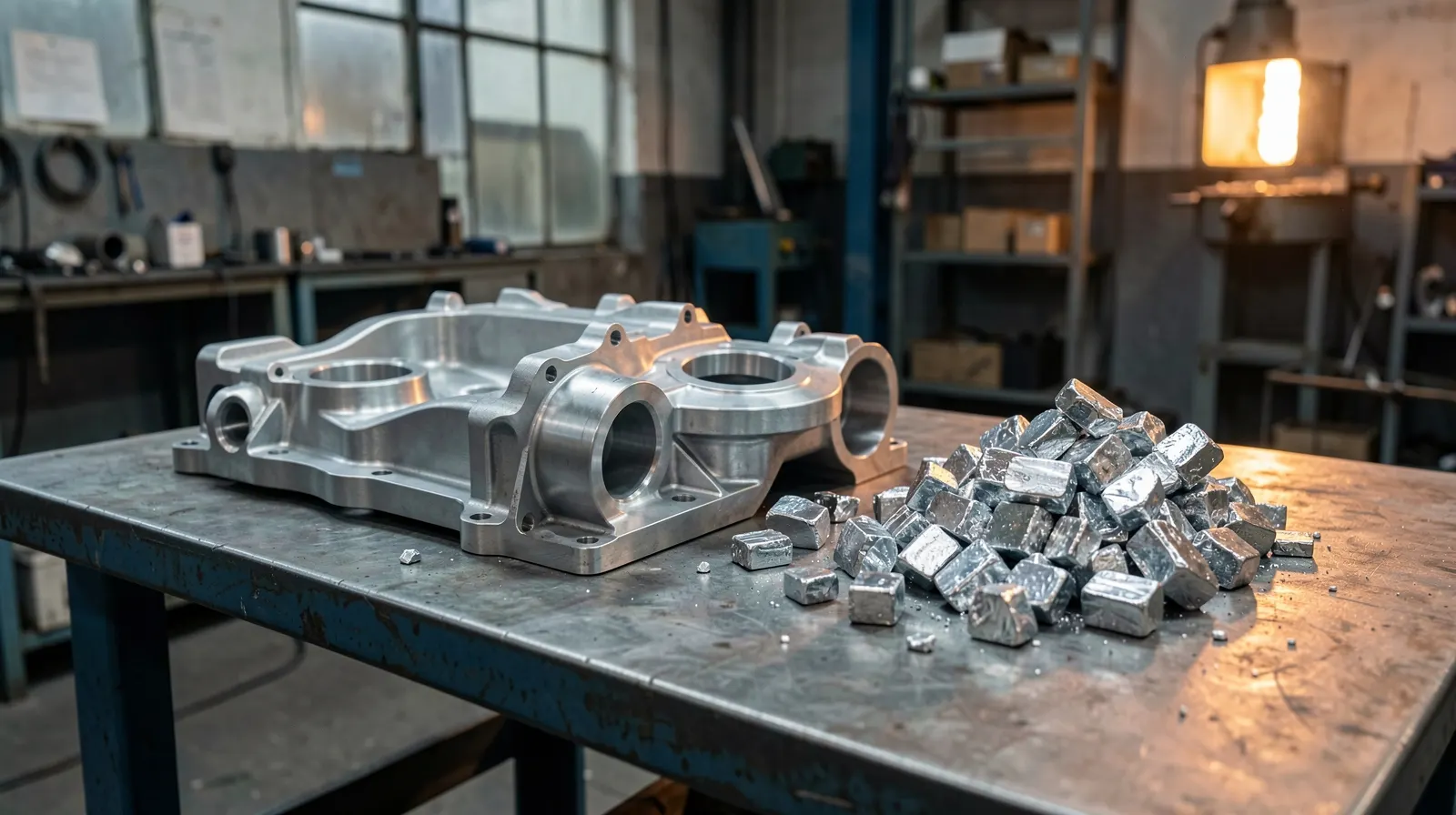
On the supplier sheet 441 and 553 sit side by side, the price gap is plain to see, and procurement is inclined to say "both are 98.5% Si, buy the cheaper one." But on the casting line — or inside a silicone reactor — the difference isn't in the purity at all. It lives in three trace elements: iron, aluminum, calcium. Pick the wrong grade and it comes back to you as either a brittle casting or a low process yield.
TL;DR: The three digits in the name are one-tenth of the maximum Fe / Al / Ca values. 441 → Fe≤0.4%, Al≤0.4%, Ca≤0.1% (tighter, premium). 553 → Fe≤0.5%, Al≤0.5%, Ca≤0.3% (looser, economical). Si in both runs typically ≥98.5–99%. Tight spec, primary Al-Si casting and silicone chemistry → 441; secondary aluminum and general alloying → 553. Solar/semiconductor grade is neither of these.
What the name is actually encoding
A Si metal grade code isn't arbitrary — it reads the impurity ceiling straight off the label. Left to right, the three digits are ten times the maximum iron, aluminum and calcium percentage. So 4-4-1 reads as: Fe at most 0.4%, Al at most 0.4%, Ca at most 0.1%. And 5-5-3 reads as: Fe at most 0.5%, Al at most 0.5%, Ca at most 0.3%. Silicon itself typically lands in the 98.5–99% band in both grades; the real split isn't in the baseline silicon, it's in the impurity ceiling.
The sharpest difference is in calcium. The 441 Ca ceiling is 0.1%; 553 is three times as loose at 0.3%. On iron and aluminum the gap is a 0.1% margin, but that threefold calcium spread is — as you'll see in a moment — the axis that flips the decision on both the casting and the chemistry side. 441 is tighter, cleaner, more expensive; 553 is more tolerant and noticeably cheaper per tonne. The question isn't "which is better," it's "which impurity does your process forgive."
Why Fe and Ca drive the call in aluminum casting
The single biggest market for Si metal is primary aluminum alloying. Al-Si casting alloys — A356 in automotive (Si ~7%) or die-cast ADC12 (Si ~9.5–12%) — owe their fluidity and wear resistance to silicon. Silicon raises the melt's ability to fill the die, so the casting picks up thinner sections without risk. So far, so good. The problem is the impurity that rides along.
Iron is the critical one here. When aluminum, silicon and iron come together they form Al-Fe-Si intermetallics, and the β-phase of these is needle-like, plate-shaped and brittle. These needles act as crack initiators inside the matrix, dropping ductility and fatigue life. If you're casting a safety part — a wheel, a chassis component, a block — the Fe ceiling directly sets the mechanical rejection rate. The 441 ceiling of 0.4% Fe, against 553's 0.5%, limits the volume of that needle phase.
Calcium is the second axis. Ca affects hydrogen solubility and porosity tendency in the melt, and it also upsets the eutectic modification balance you run with Sr or Na in Al-Si alloys. High Ca in a modified alloy means unexpected phase morphology and gas porosity. That's why 441's 0.1% Ca ceiling is the standard for tight casting spec; 553's 0.3% can introduce swings on a line that depends on modification discipline.
Silicone chemistry: trace elements flip process selectivity
The second big use is the direct process (Rochow process), the first step in silicone production. Powdered Si metal is reacted with methyl chloride over a copper catalyst to produce a mix of methylchlorosilanes, and from there come silicone oils, elastomers and resins. The commercial value of this reaction is in selectivity: maximizing the yield of the desired dimethyldichlorosilane.
Trace elements — Al, Ca, Fe and especially phosphorus — directly affect the selectivity and reaction rate of the copper catalyst system. Certain impurities act like promoters; above certain levels they cut selectivity and raise the fraction of unwanted byproducts. That's why silicone producers don't buy grade at random; most run at 441 level, or on a bespoke spec written to their own reactor chemistry. Here the decision driver isn't mechanical, it's chemical: the impurity ceiling locks in catalyst performance.
One clear warning: both 441 and 553 are metallurgical-grade silicon. Solar-grade or semiconductor-grade silicon demands far higher purity — impurities are discussed at ppm, even ppb, and require additional refining (e.g. the Siemens process). The 441/553 debate never enters that world; if a customer says "Si metal for solar," the material on the table isn't this, and that's worth clearing up at the outset.
Selection matrix: when to use which
The decision comes down to four variables. First, Fe-Ca tolerance: if it's safety-critical primary Al-Si casting that needs tight intermetallic and porosity control, 441. If it's secondary (scrap-based) aluminum and general alloying running a wider composition window, 553 is already enough. Second, trace-element control in the chemistry process: if you're feeding a Rochow reactor, a controlled grade — 441 or a bespoke spec — isn't up for negotiation. Third, cost: 441 carries a premium, 553 is economical per tonne; where the spec allows, dropping to 553 is a direct saving. Fourth, lump size and melting behavior: piece-size distribution affects melt rate and furnace efficiency, and that needs to be fixed in the packaging spec.
Expert view, time-stamped: through the second half of 2026, while silicon-metal pricing stays volatile on regional energy costs, there's no technical case for the secondary-aluminum and general-alloy lines that 553 forgives to pay the 441 premium — narrowing grade to the real Fe-Ca tolerance of the application is the cleanest cost lever in a choppy price environment. On the other hand, the cost of a casting rejection or a loss of reactor selectivity quickly dwarfs the price gap between 441 and 553; on a tight line, dropping grade is false economy.
Field note (anonymized): a die-casting line had locked all its buying to 553 for supply simplicity; no problem on non-safety general parts, but on a thin-section, fatigue-loaded part a microstructure review showed brittle β-Al-Fe-Si needles and rejections climbed. The only change was moving that part family to 441 — the tighter Fe and Ca ceiling cut the needle-phase volume and the rejection rate returned to normal. General casting stayed on 553; splitting grade by part criticality came out cheaper than the convenience of a single grade.
Frequently Asked Questions
What exactly is the difference between 441 and 553? The difference isn't in purity, it's in the impurity ceiling. 441 → Fe≤0.4%, Al≤0.4%, Ca≤0.1%; 553 → Fe≤0.5%, Al≤0.5%, Ca≤0.3%. Si in both is typically ≥98.5–99%. The sharpest split is calcium: 553 allows three times the Ca of 441. 441 is premium and tight, 553 economical and tolerant. For a spec match, info@arsammetal.com.
Which one should I buy for aluminum casting? For safety-critical primary Al-Si casting (wheels, chassis, thin-section fatigue parts), 441; the tight Fe-Ca ceiling limits brittle β-Al-Fe-Si intermetallic and porosity risk. For secondary/scrap-based aluminum and general alloying, 553 is enough and more economical. The call depends on the mechanical criticality of the part; for an assessment tuned to your line, /teklif.
Is 441 enough for silicone (silicone resin/oil) production? Usually yes, but it depends on your reactor chemistry. In the Rochow direct process, Al, Ca, Fe and P affect catalyst selectivity, so most producers run at 441 level or on a bespoke spec written to their own reactor. Share your target trace-element profile and we'll fix the right spec together: info@arsammetal.com.
Is 441 or 553 used for solar panels / semiconductors? No. 441 and 553 are metallurgical-grade silicon; solar-grade and semiconductor-grade silicon require ppm–ppb purity and additional refining, and fall outside this discussion. If your application is photovoltaic or electronic, these grades are not the right material. For a pointer to the correct product, write in via /teklif.
Arsam Metal supplies both grades (441 and 553) from multi-regional sourcing; every lot ships with COA + MTC (EN 10204 3.1) + radiation certificate. Typical packaging is 10–100 mm lump, jumbo big bag / FCL; bonded stock near customs enables fast dispatch, and Incoterms are flexible (FOB/CIF/CFR/DAP). HS 2804.69. For a spec match and samples, get in touch.
Mehdi
Technical Metallurgist
Facing a similar problem?
Arsam's technical desk handles every supply and production question. 48-hour quote, technical consulting included.