
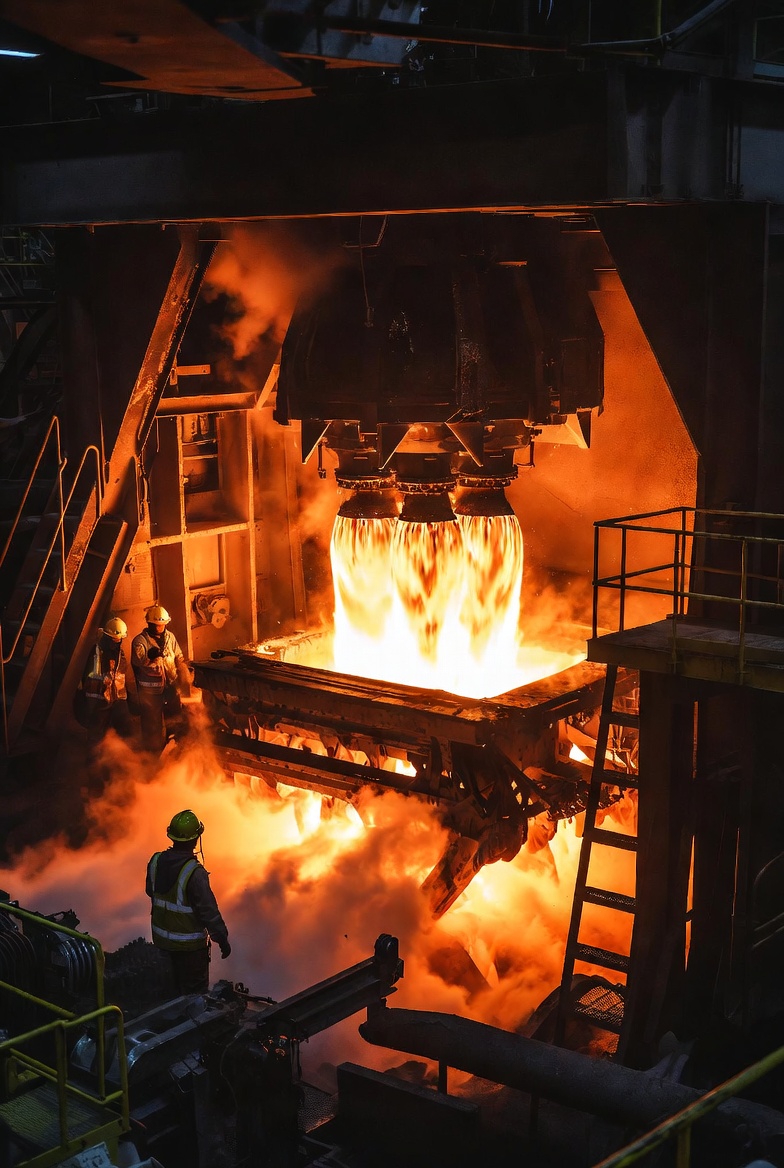
Silicon carbide in the induction furnace: instead of FeSi, or alongside it?
Metallurgical SiC brings both Si and C and keeps nucleation alive longer than FeSi. How much FeSi and carbon it replaces, when to add it, and the break-even price.
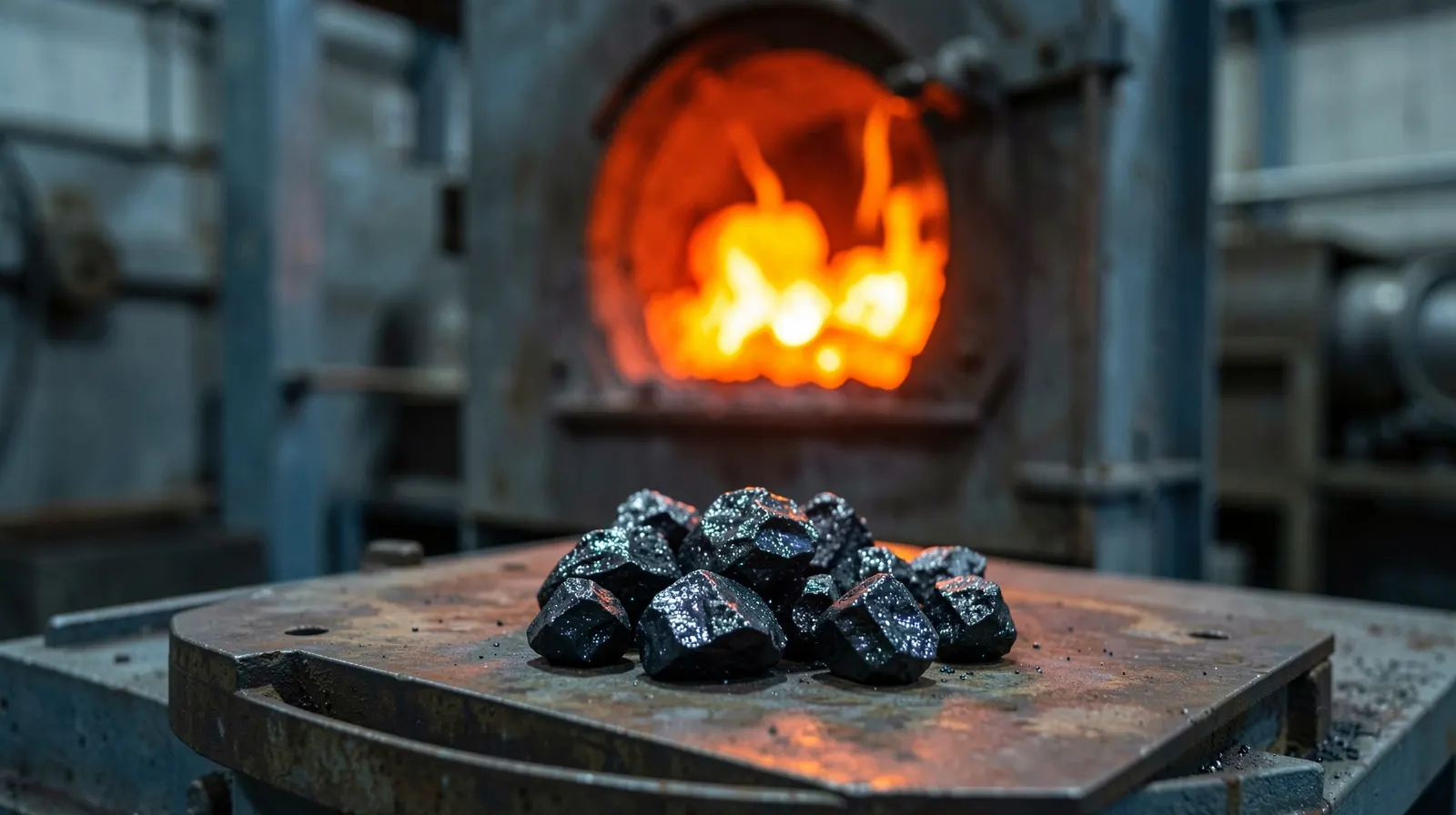
Every foundry that cuts pig iron out of the charge runs into the same gap. The carbon and silicon that pig iron used to carry have to come from somewhere, and habit says FeSi75 plus a recarburizer. Metallurgical silicon carbide offers a third route by delivering both in one material. A buyer who sees SiC as "one line item instead of two" is looking at half the picture, though. The bigger difference shows up in how the melt nucleates, and it only shows up if the material goes in at the right moment and in the right amount.
Short answer: Metallurgical SiC (88-92% SiC) is 70% Si and 30% C by mass. Charged with the solid scrap, it transferred 53-95% of its silicon and 83-98% of its carbon into the melt in trials at the Silesian University of Technology; thrown onto the bath surface, recovery fell to 41% and 35%. SiC does not retire FeSi. Taking the base Si and C from SiC in the charge and doing the final trim with FeSi is the cleanest set-up for scrap-heavy grey and ductile iron.
What one tonne of SiC leaves in the melt
This is the calculation most quote comparisons skip. A tonne of 88% SiC carries 616 kg of silicon and 264 kg of carbon in theory. The rest is free carbon, unreacted SiO₂ and a little iron. If you want to do the same job with two separate materials, FeSi75 and the recarburizer both belong in the comparison; pricing SiC against FeSi alone gives the wrong answer.
As a working assumption, take 90% recovery for both Si and C from SiC, 95% for FeSi75, and a recarburizer at 98.5% C with 90% recovery. One tonne of SiC then leaves about 554 kg Si and 238 kg C, which is what 778 kg of FeSi75 plus 268 kg of recarburizer would deliver. That gives a rough break-even rule:
SiC break-even price ≈ 0.78 × FeSi75 price + 0.27 × recarburizer price
With round illustrative numbers (not market prices, just to show the arithmetic): at $1,400/t for FeSi75 and $600/t for recarburizer, SiC pays for itself as a plain Si and C carrier at anything up to $1,254/t. The nucleation effect has no price tag in that formula. Your own chill, inoculant consumption and scrap-rate data put a number on it.
Cleanliness is a separate line. In the comparison Janerka and co-authors reproduce, metallurgical SiC carries 31% C, 0.07% S and 300 ppm N, against 98% C, 1.5% S and 6,000 ppm N for calcined petroleum coke. As the scrap share climbs, shrinking your sulphur and nitrogen sources is a direct cut in pinhole risk.
When to add it: with the charge, not on the bath
SiC does not melt. It decomposes at roughly 2,700 °C, so in an induction furnace it dissolves into the iron and releases Si and C that way. Dissolution runs faster in iron that is not yet carbon-saturated and slows as the melt approaches saturation. In practice: put the SiC in before the recarburizer, between layers of solid charge.
In the Silesian trials (20 kg high-frequency furnace, steel-scrap-based GJL 200 and GJL 250), the same SiC gave 88.6-94.8% silicon recovery when placed in the solid charge and 41% when added to the bath surface. Carbon showed an even harder split: 83-87% against 35%. A good part of the surface-added SiC was still floating undissolved after ten minutes of stirring. Common shop practice agrees: add it when roughly half the charge is in, and keep it under 1% of total charge weight.
Grain size decides a lot here. For induction melting, a 0-10 mm fraction dissolves quickly; 10-50 mm lumps do their job in EAF and ladle deoxidation, but in a small induction furnace they can end up floating if they go in late. There is a side benefit as well: 2.5-5 kg of SiC per tonne stops fayalite, formed when SiO₂ and iron oxide react during melting, from building up on the furnace wall. For a furnace that keeps growing a crust on its lining, that small dose alone justifies a trial.
Nucleation: why the effect outlasts FeSi
FeSi-based inoculants dissolve fast and their effect starts fading within minutes. SiC dissolves more slowly, so it leaves longer-lived nucleation sites in the melt. That difference pays off most in steel-scrap-based melts, where nucleation is weak to begin with.
The numbers: in the same study, adding 0.1% SiC to the pouring stream raised the minimum eutectic temperature (Temin) by 2.9 to 7.4 °C. The authors aim to keep Temin above 1,135 °C, and at 1,142 °C nucleation reaches the 80% level. The higher Temin goes, the lower the tendency to hard spots (chill).
In ductile iron the picture is mixed, and it deserves an honest read. In a 2.3-tonne mains-frequency furnace, a GJS 400-15 melted with no pig iron at all and 20 kg of SiC in the charge reached 384 nodules/mm², against 310/mm² in the reference heat with 1,200 kg of pig iron. The same heat saw tensile strength drop from 474 to 441 MPa and elongation from 23.5% to 18%, still inside the standard. For GJS 500-7, the heats with and without pig iron came out at 542 and 551 MPa, practically level. So SiC made a pig-iron-free charge workable and strengthened nucleation, but it did not carry the mechanical properties on its own.
One more boundary: these heats were still ladle-inoculated (SB5) after magnesium treatment. SiC is preconditioning in the furnace, not a replacement for ladle inoculation. Mg fade is a separate matter, covered in our piece on FeSiMg and the 10-minute window.
Instead of FeSi, or alongside it?
Where SiC wins is clear: a low-pig-iron, high-scrap charge; a line that wants to keep sulphur and nitrogen down; an induction furnace that keeps growing fayalite crust on its lining. If two of those three describe your shop, a trial is worth it.
Where FeSi stays is just as clear. The last silicon adjustment before pouring has to be fast and precise, and you cannot do that with a slow-dissolving material. If carbon is already on target, SiC pushes it higher, so it is the wrong tool for a melt that is short on Si but not on C. Low-carbon steel grades keep FeSi for the same reason. The set-up we recommend is a pair: base Si and C from SiC in the charge, final correction from FeSi.
Expert call, with a date lock: a foundry planning to raise its scrap share in the last quarter of 2026 should run SiC for three months, October to December, at 0.5% of the charge, cut FeSi75 and recarburizer by the 0.78 and 0.27 ratios above, and log Temin and a chill-wedge reading on every heat. Make the January 2027 buying decision on those three months of scrap rate, not on an invoice comparison.
CBAM note for foundries selling into the EU
Metallurgical SiC is classified under CN 2849 20 00 and does not appear in CBAM Annex I. FeSi (7202 2x) sits on the regulation's exception list too. An SiC enquiry for 20 tonnes that reached us from the EU this summer listed CBAM embedded-emissions data among the required documents; for these two materials, no CBAM declaration arises on the importer's side. Ferro-manganese and ferro-chromium change the picture, as explained in the updated version of our CBAM article.
Frequently Asked Questions
Can SiC replace FeSi completely? No. SiC brings silicon together with carbon and dissolves slowly, so it is not suited to the precise Si correction before pouring. Base Si and C from SiC in the charge, final trim from FeSi, is the most balanced set-up.
How much SiC should I add? Typically 0.3-0.5% of the charge for preconditioning. Scrap-heavy lines that want most of their Si and C from SiC go up to 1%; in the Silesian trials, up to 0.91% SiC raised no impurities in the melt. Cut recarburizer and FeSi at the same time, or you will over-alloy.
Why is adding SiC to the bath surface inefficient? Because SiC does not melt; it dissolves, and a piece floating on top never gets enough contact time. In the trials, surface-added SiC recovered only 41% of its silicon and 35% of its carbon, against 88-95% and 83-87% when charged with the solid scrap.
Which grain size fits an induction furnace? 0-10 mm. That fraction dissolves quickly between layers of solid charge. 10-50 mm lumps suit EAF and ladle deoxidation; in a small induction furnace they can float if they go in late.
Arsam Metal supplies metallurgical SiC at SiC ≥90%, free C ≤2.0% and Fe₂O₃ ≤1.5%, in 0-10 mm and 10-50 mm fractions, packed in 1 t jumbo big bags, with COA and MTC (EN 10204 3.1) on every lot. If you are planning a trial, check the spec on the SiC product page and ask for SiC, FeSi75 and recarburizer in one quote through the RFQ form; we will run the break-even with your numbers.
Sources: Janerka K., Kostrzewski Ł., Stawarz M., Jezierski J., Szajnar J., "Various aspects of application of silicon carbide in the process of cast iron melting", Archives of Metallurgy and Materials 67(3), 2022, pp. 1093-1098, doi:10.24425/amm.2022.139708 · Regulation (EU) 2023/956, Annex I (EUR-Lex).
Mehdi
Technical Metallurgist
هل تواجه مشكلة مماثلة؟
فريق أرسام التقني جاهز لأي سؤال يتعلق بالتوريد والإنتاج. عرض سعر خلال 48 ساعة، الاستشارات التقنية مشمولة.